
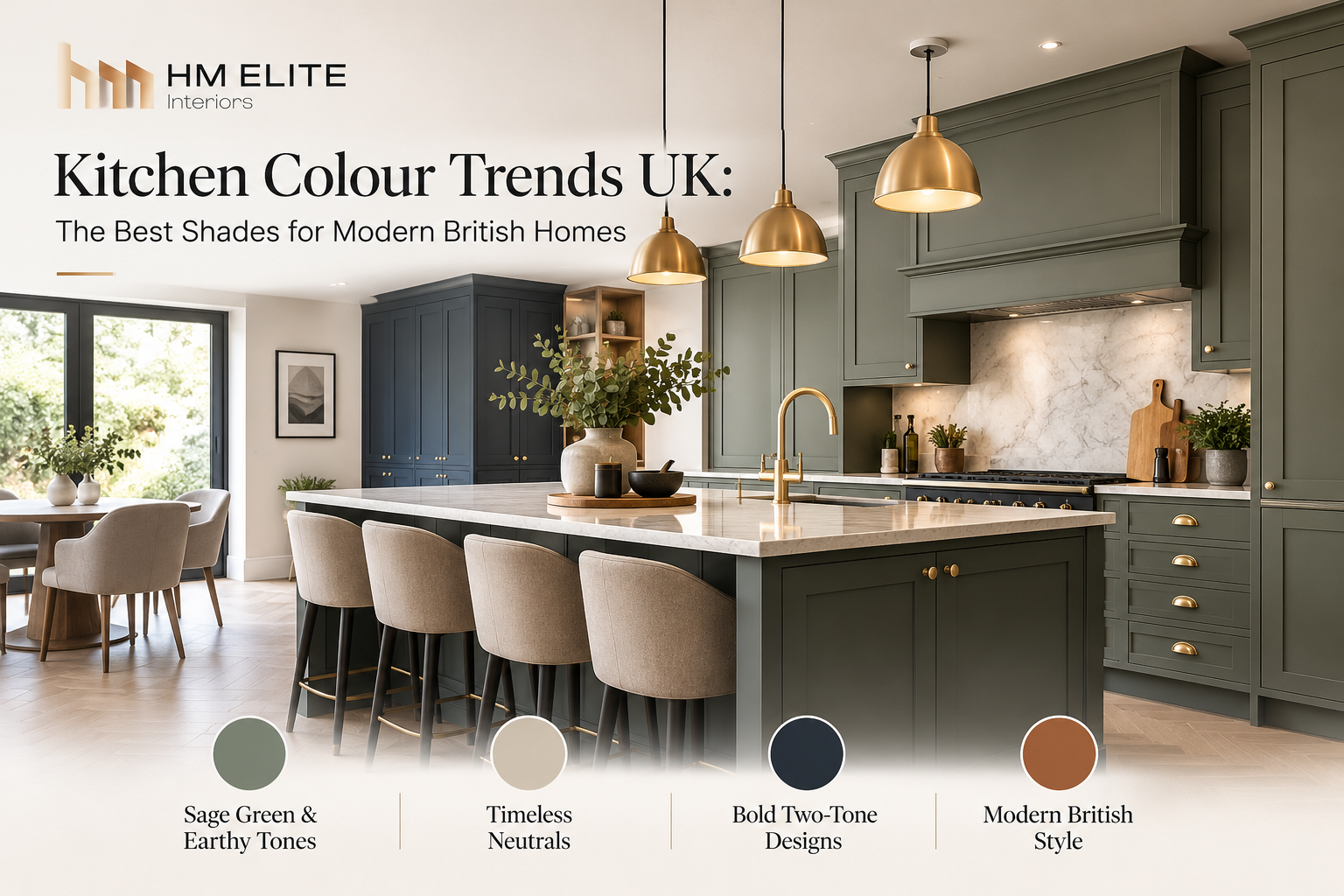
Choosing a kitchen colour is rarely about paint alone. It is a decision you will live with every morning for years, which is why so many people stall at the sample stage and ask the same two questions: what is actually in fashion, and what will still look right in 2030?
This guide answers both. It covers the kitchen colour trends UK homeowners are choosing, drawn from what paint brands, designers and interiors editors are saying, plus kitchen colour ideas for 2026 and beyond that suit real British homes: narrow terraces, north-facing extensions and open-plan family spaces. The short version is that the UK is moving away from stark white and cool grey towards warmer, softer colour with plenty of texture.
What are the biggest kitchen colour trends in the UK right now?
Ask a dozen kitchen experts and one word keeps coming up: warmth. When Which? spoke to industry designers about 2026, the phrase “warm minimalism” cropped up repeatedly, meaning warm neutrals, textured matt finishes and woodgrain, with clean lines and less clutter. Homes & Gardens’ predictions for 2027 point the same way, with the most stylish kitchens staying warm and earthy.
Within that big idea, five trending kitchen colours stand out:
- Warm neutrals and earth tones. Creamy whites, sandy beiges and clay shades are replacing stark white, giving kitchens a calmer, more natural feel.
- Sage and olive green. One widely shared UK trend guide names sage green as Britain’s favourite kitchen colour, with olive growing fastest.
- Soft blues. Dulux broke with tradition for 2026 and named three blues as its colours of the year, under the banner The Rhythm of Blues.
- Burgundy and deep reds. Graham & Brown chose Divine Damson, a rich merlot red, while Little Greene’s creative director expects more confidence with red, pink and purple tones.
- Muted brown and walnut warmth. For 2027, designers are talking about softer, muted browns rather than very dark chocolate shades, and woodgrain doors are part of the same story.
One note of caution. Some designers quoted by Ideal Home believe deep forest green and navy, once the go-to statement shades, are starting to feel overdone, and that gentler earthy tones, subtle greens and soft plaster pinks come next. That does not make them wrong choices. It simply means that if you are choosing a colour only because you have seen it everywhere, its softer cousin may age better.
Which kitchen colours work best in UK homes?
There is no single winner, because the best kitchen colours in the UK depend on your light, room size and style. Here is how the main contenders behave.
Sage and olive green
Green connects a kitchen to the garden, which suits British homes well. Sage is the gentler option and works on both painted shaker doors and sleek handleless fronts. Olive is richer and looks particularly good against natural oak and warm stone.
Warm neutrals: cream, oat and putty
These are the most forgiving shades. They bounce light around, flatter almost every worktop and feel lived in rather than showroom-perfect. If you are moving on from all-white, this is the easiest first step.
Soft blues and blue-greys
Pale, muted blues feel calm and fresh and suit traditional and modern kitchens alike. Choose carefully if your room faces north, because cool undertones can look colder than expected.
Burgundy, plum and deep red
These are dramatic, but they do not have to take over. Many designers use them on an island or a bank of tall units and keep the rest of the room quiet, adding depth without making a family kitchen feel heavy.
Muted brown and woodgrain
Warm brown tones and woodgrain finishes add texture that flat colour cannot. They work particularly well on islands, tall units and open shelving, where a little depth goes a long way.
What is the best kitchen colour for a small or north-facing room?
Many UK kitchens are modest in size, and plenty face north. The old advice was to paint everything white, but the reality is more interesting.
Little Greene’s creative director, Ruth Mottershead, explains that north-facing rooms tend to look cooler and flatter because they receive very little direct sun. Kitchen design manager Charlotte Butler adds that the indirect, slightly blue daylight amplifies any cool undertone, so a white that looked fresh in the shop can turn stark and sterile at home.
The fix is to lean warm. Designers recommend chalky, mineral shades such as pale limestone, soft oat or light putty to counter grey undertones and restore balance. Yellow-based neutrals and dusty pinks also add warmth to a room that lacks sunshine.
South-facing kitchens have the opposite issue: strong sunlight can bleach out lighter colours, so a darker shade can shine here. And if your kitchen is small and you love dark colour, designers say it can work as a deliberate “jewel box”, provided you embrace the cosiness and plan your lighting well.
What are the best kitchen colour combinations?
A reliable rule is to pair one calm base colour with one colour that has character. These kitchen colour combinations work in most UK homes:
- Neutral run, contrast island. Keep the perimeter cabinets soft and put a deeper green, blue or burgundy on the island. It is the simplest way to add colour without committing the whole room.
- Light above, deeper below. Lighter wall units with darker base units keep a room feeling open while grounding it. This horizontal split is one of the two most common ways to do a two-tone kitchen.
- Tonal layering. Instead of painting everything one colour, layer shades from the same family. Trend analysts at Smile Kitchens describe this as a refined alternative to single-colour drenching.
- Paint plus wood. Pair sage, soft pink or muted blue with a woodgrain tone for warmth and texture.
If you want to go further, our guide to two-tone and multi-tone kitchen cabinetry walks through how to layer colour with intention. And if your kitchen opens onto a living area, the same palette can continue onto a media wall, so the whole space feels designed together.
Should you follow the trend or choose something timeless?
Both, in the right places. Cabinets are the largest and most expensive surface in the room, and the hardest to change. Walls, accessories and even an island are far easier to refresh.
A sensible approach is to keep the main run of cabinets and the worktops calm and warm, then put the trend colour on an island, a tall bank of units, a splashback or the walls. If that colour fades from fashion, the change is small. If it stays, you have a kitchen with personality.
How do you test a kitchen colour before committing?
Colour behaves differently in every room, so test before you decide.
- Check it beside real surfaces. Compare samples against your cabinets, worktops, flooring and tiles, not on a white wall alone.
- Look at different times of day. View it in morning light, evening light and under your actual LED bulbs, because the same shade can shift noticeably.
- Think about daily wear. Kitchens deal with steam, splashes and constant touching, so choose a finish that suits how you cook and clean.
How do you bring your colour choice to life?
Once you know your palette, the next question is how well your kitchen is built to carry it. This is where a made-to-measure approach pays off. With fitted kitchens designed and manufactured in the UK to your exact dimensions, there are no awkward gaps or mismatched panels to break up a carefully chosen colour.
At HM Elite Interiors, you can choose from over 200 colours and finishes, from handleless matt slab doors to painted shaker fronts, with worktops, splashbacks and handles selected to sit alongside them. Your quote is all-inclusive and itemised in writing, soft close doors and drawers are standard, our own fitters carry out the installation, and everything comes with a 7-year guarantee.
The best first step is to book a free design consultation. We will talk through your room, your light and the colours you are drawn to, then turn them into a kitchen you will still love years from now.
Frequently asked questions
1.What is the most popular kitchen colour in the UK right now?
Sage green is widely reported as the favourite, with olive the fastest-growing shade, alongside warm neutrals such as cream, oat and stone.
2.Are white kitchens out of date?
Not at all, but stark white is giving way to warmer whites, creams and “new neutrals” that feel softer and more inviting.
3.Do dark colours make a small kitchen feel smaller?
Not necessarily. Light shades bounce more light, but a dark colour can make a small kitchen feel cosy and deliberate if the lighting is well planned.